Chapter 17 - Stars and Solar System Exercise 234
Solution 1
(c) A constellation
Concept Insight: A constellation is not a member of the Solar System. Constellations are groups of stars that form recognizable shapes.
Concept Insight: A constellation is not a member of the Solar System. Constellations are groups of stars that form recognizable shapes.
Solution 2
(a) Sirius
Sirius is a star and not a planet of the Sun.
Sirius is a star and not a planet of the Sun.
Solution 3
(a) Phases of the Moon occur because we can see only that part of the Moon which reflects light towards us.
Solution 4
(a) The planet which is farthest from the Sun is __Neptune__.
(b) The planet which appears reddish in colour is __Mars__.
(c) A group of stars that appear to form a pattern in the sky is known as a __constellation__.
(d) A celestial body that revolves around a planet is known as a _satellite_.
(e) Shooting stars are actually not _meteor_ .
Concept Insight: Shooting stars are not stars, they are meteors.
(f) Asteroids are found between the orbits of _Mars _ and __Jupiter_.
Concept Insight: Asteroids are large pieces of rocks which orbit around the Sun and are found in between the orbits of Mars and Jupiter.
(b) The planet which appears reddish in colour is __Mars__.
(c) A group of stars that appear to form a pattern in the sky is known as a __constellation__.
(d) A celestial body that revolves around a planet is known as a _satellite_.
(e) Shooting stars are actually not _meteor_ .
Concept Insight: Shooting stars are not stars, they are meteors.
(f) Asteroids are found between the orbits of _Mars _ and __Jupiter_.
Concept Insight: Asteroids are large pieces of rocks which orbit around the Sun and are found in between the orbits of Mars and Jupiter.
Solution 5
(a) False
Concept Insight: Pole Star is not a member of the Solar System.
(b) True
(c) False
Concept Insight: Neptune is the farthest planet in the solar system.
(d) True
(e) False
Concept Insight: There are eight planets in the Solar System. They are Mercury, Venus, Earth, Mars, Jupiter, Saturn, Uranus and Neptune.
(f) False
Concept Insight: Constellation Orion can be seen during winters around late evenings. It is one of the most magnificent constellations in the sky, visible to the naked eyes.
Concept Insight: Pole Star is not a member of the Solar System.
(b) True
(c) False
Concept Insight: Neptune is the farthest planet in the solar system.
(d) True
(e) False
Concept Insight: There are eight planets in the Solar System. They are Mercury, Venus, Earth, Mars, Jupiter, Saturn, Uranus and Neptune.
(f) False
Concept Insight: Constellation Orion can be seen during winters around late evenings. It is one of the most magnificent constellations in the sky, visible to the naked eyes.
Chapter 17 - Stars and Solar System Exercise 235
Solution 1
| A | B | ||
| (i) | Inner planets | (g), (e) | Mars, Earth |
| (ii) | Outer planets | (a) | Saturn |
| (iii) | Constellation | (c), (f) | Great Bear, Orion |
| (iv) | Satellite of the Earth | (d) | Moon |
Solution 2
Venus appears in the western sky just after sunset and is called the evening star
Solution 3
The largest planet of the Solar System is Jupiter (Brihaspati).
Solution 4
A constellation is a group of stars that forms a recognizable pattern in the sky.
The two well known constellations are Ursa Major and Orion.
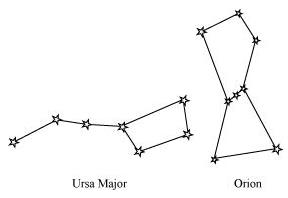
The two well known constellations are Ursa Major and Orion.
Solution 5
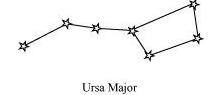
(a) Ursa Major appears like a big dipper.
(b) Orion appears like a hunter.
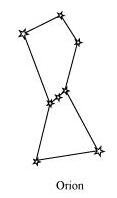
(b) Orion appears like a hunter.
Solution 6
(i) Asteroids
Concept Insight: Asteroids are small celestial objects which revolve around the Sun between the orbits of Mars and Jupiter.
(ii) Meteors
Concept Insight: Meteors are small celestial objects that are seen as bright streaks of light in the sky.
Concept Insight: Asteroids are small celestial objects which revolve around the Sun between the orbits of Mars and Jupiter.
(ii) Meteors
Concept Insight: Meteors are small celestial objects that are seen as bright streaks of light in the sky.
Solution 7
In order to locate the Pole star in the sky, first of all Ursa Major or Big Dipper constellation must be located. The bowl of the Big Dipper consists of four bright stars (as shown in the given figure).
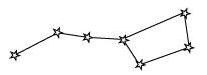
Consider two stars at the end of this bowl. Now, draw an imaginary straight line towards the Northern direction connecting these two stars (as shown in the given figure).
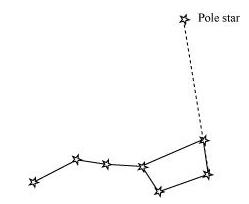
This imaginary line meets a star called the Pole Star. The length of the imaginary line from the bowl is about five times the distance between the two stars of the bowl.
Consider two stars at the end of this bowl. Now, draw an imaginary straight line towards the Northern direction connecting these two stars (as shown in the given figure).
This imaginary line meets a star called the Pole Star. The length of the imaginary line from the bowl is about five times the distance between the two stars of the bowl.
Solution 8
No. The Earth rotates from West to East on its axis. Hence, all stars in the sky (except the Pole star) appear to move from East to West. With reference to the Earth, the Pole star does not appear to move in the sky because it is located above the axis of rotation of the Earth in the north direction. It appears to remain stationary at a point in the sky.
Solution 9
The Sun is nearly 150,000,000 kilometres (150 million km) away from the Earth.
The distance of the stars from the Earth and the distance between the stars are very large. It is inconvenient to express these distances in kilometres (km). Thus, these large distances are expressed in light years. One light year is the distance travelled by light in one year. One light year is equal to 9.46 × 10¹² km.
A star is located eight light years away from the Earth. This means that the distance between the star and the Earth is equal to the distance travelled by light in eight years, i.e., a star is located 8 × (9.46 × 1012) = 7.6 × 10¹³ km away from the Earth.
The distance of the stars from the Earth and the distance between the stars are very large. It is inconvenient to express these distances in kilometres (km). Thus, these large distances are expressed in light years. One light year is the distance travelled by light in one year. One light year is equal to 9.46 × 10¹² km.
A star is located eight light years away from the Earth. This means that the distance between the star and the Earth is equal to the distance travelled by light in eight years, i.e., a star is located 8 × (9.46 × 1012) = 7.6 × 10¹³ km away from the Earth.
Solution 10
Earth and Jupiter can be considered as two spheres with radii R and R' respectively. Given that the radius of Jupiter is 11 times the radius of the Earth.
Thus, R' = 11 R
Volume of a sphere of radius r is given as
Volume of the Earth
And, volume of Jupiter
The ratio of the volumes of Jupiter and Earth
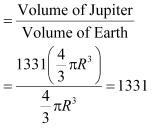
Hence, this ratio suggests that Jupiter can accommodate 1331 number of Earths within it.
Thus, R' = 11 R
Volume of a sphere of radius r is given as
Volume of the Earth
And, volume of Jupiter
The ratio of the volumes of Jupiter and Earth
Hence, this ratio suggests that Jupiter can accommodate 1331 number of Earths within it.
Solution 11
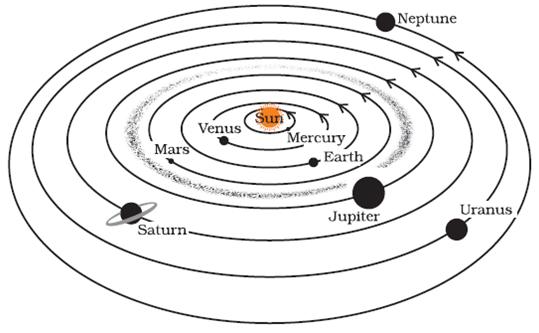
Planets of the Solar System in sequence of their distances from the Sun are: Mercury, Venus, Earth, Mars, Jupiter, Saturn, Uranus, and Neptune. Therefore, Boojho's sketch of the Solar System is not correct because he has interchanged the positions of Mars and Venus and also the positions of Uranus and Neptune. Also, he has shown the Asteroid belt in the gap between the orbits of Jupiter and Saturn. This is not correct. The asteroid belt is located between the orbits of Mars and Jupiter. The correct sketch of the Solar System is shown in the given figur.
Comments
Post a Comment